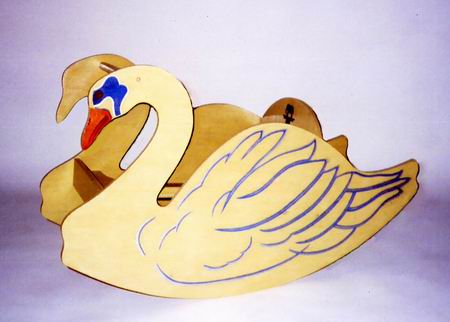
ROCKING
SWAN
As
we have mentioned in our mission statement, we
take pride in restoring sentimental furniture,
…“preserving the warmth and feeling
of the piece, preparing it for many more years
of service” was so true for this restoration.
As you can see it’s not a piece of furniture
at all, but it was made from wood and it was very
close to the heart of the client.
This
child’s toy was literally handed to us in
a paper bag; disassembled, broken, worn out and
missing parts; but the client’s father had
used this toy as a baby and she wanted it restored
for her new baby to use in his memory.
The
original emblem was still in tact on the back
of the seat so we were able to trace its origin
(a service we provide for the client as well as
an aid for us in the restoration process).
The
Mengal Toy Company made hundreds of these, along
with other rocking animals in the 1920’s.
They were made with a new wood product of the
time called plywood. Another unique feature of
these toys, since they were always in the hands
of children, was the finish. They were painted
with Milk Paint, a natural, not toxic coating
that had been used for hundreds of years and could
be traced back to the early native Indians.
We
wanted to restore this toy, not so it looked new,
but to a point where it would look like it had
aged gracefully; so preserving as much of the
original patina was a priority.
Years
of outdoor use had taken its toll, especially
the rocking surfaces; they had literally had been
worn flat. The plywood laminations had not only
separated, but were missing in some places and
the runners were embedded with gravel.
The
first step was to clean off years of dirt with
a mild soap and all loose paint. Restoring the
rocking surfaces required a two-part catalyst
filler, wood laminate and glue. The missing parts
where duplicated from pictures found on the Internet;
then aged and distressed. The milk paint colors
where matched at a local woodworking store. A
“crackle” product that duplicates
the natural aging of paint was added to the new
components to blend them with the old. Then all
areas where the paint was missing were painstakingly
filled in and blended. A wash coat (thinned) of
milk paint was applied over all surfaces to give
uniformity to the colors. The final step was to
apply several coats of clear shellac (another
natural, non-toxic coating) over the entire piece
to preserve it in time.
 Back to Custom Restoration